Redesigning for Context, Not Just “Clicks”
When compliance training needs a reason to care
Skills: eLearning design — Narrative-based learning — Branching scenario design — Job aid design — Assessment development
The Situation
Harvard’s fundraising staff were required to complete an online course before gaining access to the organization’s CRM — specifically, how to enter contact reports documenting their interactions with donors and prospects. Completion was mandatory. Engagement was not.
The existing course had a fundamental problem: it taught the mechanics of data entry — the clicks — without ever explaining why that data mattered. Learners who didn’t already understand the bigger picture had no reason to care. And for those who did understand it, the course offered nothing new. The result was predictable: people clicked through to reach the end, retained little, and entered data poorly.
A different vision was needed.
The Approach
The Narrative
The redesigned course was built around a narrative — an animated story created in Articulate Replay 360 following a gift officer through real fundraising scenarios. Rather than opening with a data entry simulation, it opened with a business situation: a fundraiser navigating a donor relationship, making decisions, and facing the downstream consequences of those choices.
The story wasn’t decoration. It was the instruction. Learners experienced what good data entry enables and what poor data entry costs — before they ever touched a simulation.
Branching Scenarios
Instead of a linear path through the content, learners made choices that led to different outcomes — including a wrong-choice path that illustrated the consequences of poor data entry. Experienced staff could bypass simulations they didn’t need; newer staff got the full guided experience. The branching gave learners agency and kept them engaged rather than clicking through.
Data Entry Simulations
Simulations replaced the original demonstration-and-try model. Learners practiced the actual clicks, received feedback on errors, and had the chance to make mistakes and correct them — the conditions that support real retention.
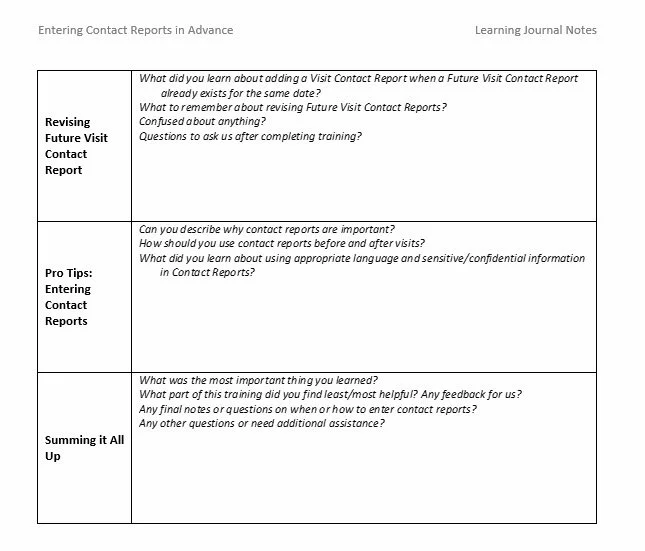
Learning Journal
Learners recorded what mattered, noted what confused them, and answered questions connecting the course content to their actual work in a learning journal embedded in the courses. A learning journal was embedded directly in the course. This encouraged learners to reflect on what they were learning, surface what they were confused about, and discourage mindless click-through. Submissions went to the education team, creating a feedback loop that helped assess both learner understanding and course effectiveness.
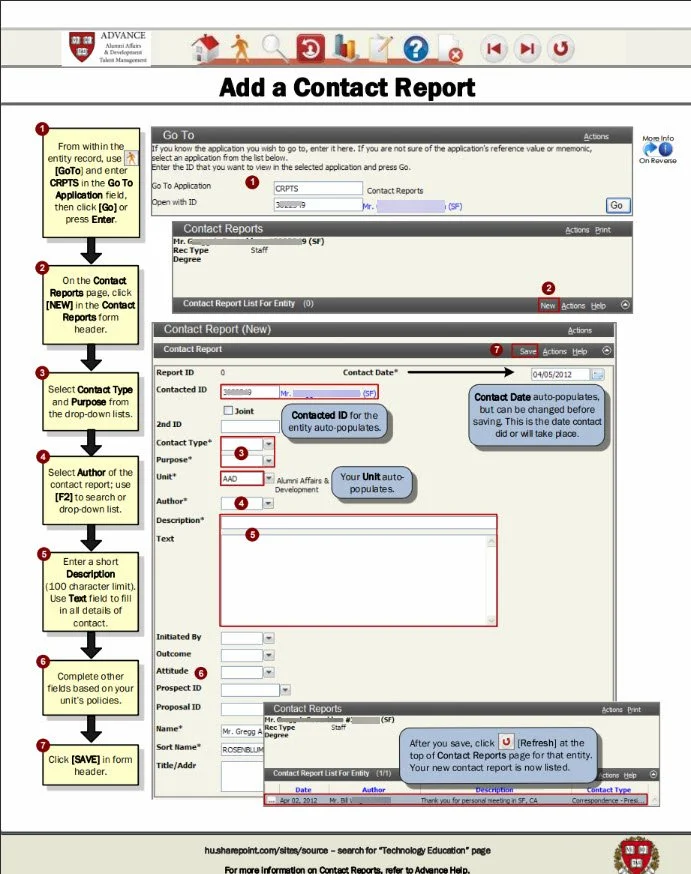
A downloadable reference guide — built in Microsoft Visio for clean workflow presentation — was available within the course and designed to be useful back at their desks, not just during training.
The Outcome
Post-training assessments showed a significantly stronger understanding of both the how and the why of contact report entry. Learners left the course not just knowing what to click, but understanding what they were contributing to — and why it mattered enough to do it carefully.
The redesign demonstrated something worth remembering: when people understand the purpose of what they’re learning, the mechanics follow. ConThitext isn’t a nice-to-have. It’s the foundation everything else is built on.
The Design Insight
The core problem wasn’t the course design. It was the assumption underneath it — that if you show people what to click, they’ll know what they’re doing.
They won’t. Not reliably. And not durably.
To truly understand how to enter data, learners first needed to understand what that data does in the world — how it connects to the organization’s relationships with donors, how it enables the work of fundraising, and what goes wrong when it’s missing or incorrect. The how-to would only stick once the why was clear.
This realization shaped every design decision that followed.
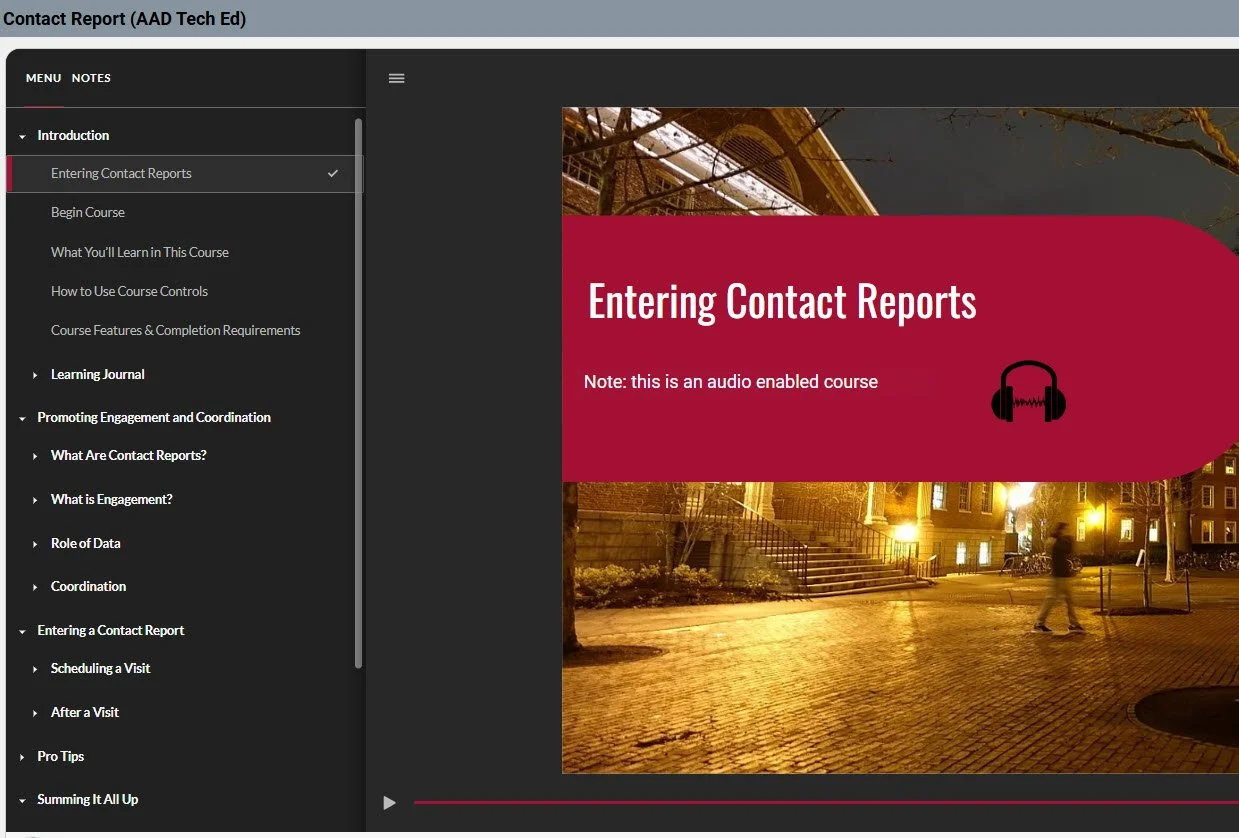
Course Menu Contents
Learning Journal Sample Page
Contact Report Job Aid