
Building Mission Alignment from Day One
When new staff need to believe in the mission before they can serve it.
Skills: Mission and culture alignment — New employee onboarding — eLearning design — Narrative-based learning — Branching scenario design — Vyond animation — Higher education advancement
The Situation
Harvard’s Advancement office raises money in service of one of the world’s most complex and storied institutions. Its staff spans an enormous range of roles — major gift officers and annual fund coordinators, yes, but also data analysts, event planners, communications professionals, and IT specialists. What every one of them shares, almost immediately upon joining, is a question they weren’t prepared for.
“Harvard has a $50 billion endowment. Why does it need more money?”
It comes from friends at dinner parties. From family members who can’t understand what they do. From skeptical colleagues in other parts of the university. And without a genuine, informed answer — one rooted in understanding and belief rather than talking points — new staff often found themselves stumbling. Not because they lacked intelligence, but because no one had given them the foundation they needed.
The existing onboarding experience was transactional. Policies, procedures, systems. It told new staff what Harvard Advancement did. It didn’t tell them why it mattered.
The Approach
The course was built around two interwoven threads that worked together throughout the experience.
The narrative thread followed an animated new hire — created in Vyond — navigating the exact conversations new Advancement staff actually have. A friend asks him over dinner why Harvard needs money. A family member expresses skepticism. A colleague in another department doesn’t understand what Advancement does. The new hire’s journey through those conversations gave learners a character to follow, a situation to recognize, and a model for how to respond — without ever feeling like a training script.
The history and impact thread wove Harvard’s origins and evolution directly into that story, grounding the narrative in something real and substantial. Learners encountered the institution’s founding, its growth across centuries, and the ways that philanthropy has shaped both its education mission — producing leaders in medicine, government, the arts, science, and industry — and its research mission, funding discoveries that have changed how the world understands disease, climate, economics, and human potential.
These two threads answered the endowment question not as a talking point but as a lived reality: the endowment sustains what exists. Philanthropy builds what’s next.
The branching architecture gave learners agency over how deeply they wanted to engage. After completing two mandatory foundation sections — the core narrative and Harvard’s history — learners entered a branching module where they could choose among additional stories of donors and their gifts: the people behind the giving, the impact those gifts made possible, and the lasting difference they created at Harvard and in the world. Learners who wanted more could follow thread after thread. Those who had what they needed could stop. The course respected both.
The Outcome
New staff across all roles will leave the course with a shared language for talking about Harvard’s mission and a genuine sense of connection to the work of the Advancement office. The animated narrative gives the content a human face. The branching structure honors the fact that different learners bring different levels of curiosity — and that honoring that difference is itself good design.
The course can be a foundational piece of the onboarding experience, giving every new employee — regardless of their role — the context, the confidence, and the conviction to represent the institution they joined.
The Design Insight
The question about the endowment isn’t really a question about finance. It’s a question about mission. And you can’t answer a mission question with a budget explanation.
The insight that shaped this course: before new staff could represent Harvard Advancement to the world, they needed to genuinely understand what philanthropy makes possible — and feel it, not just know it. Mission alignment isn’t a compliance objective. It’s an emotional and intellectual experience. It had to be designed that way.
The structure of the course followed from that insight directly. Rather than presenting information for learners to absorb, the course put them inside a conversation they recognized — and let the answers unfold naturally from there.
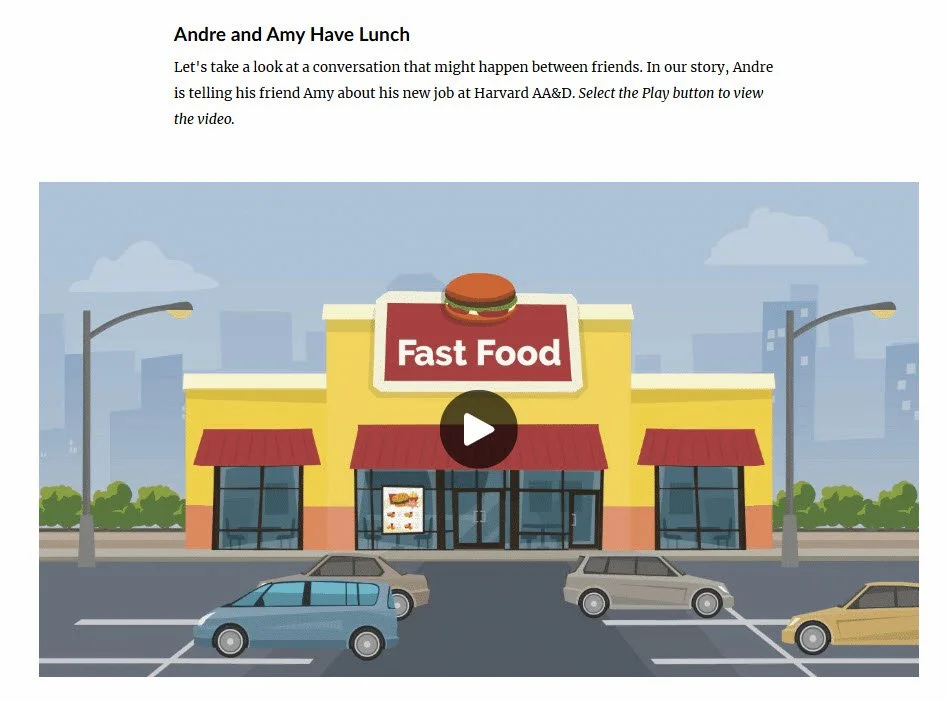
Animation Opening Screen
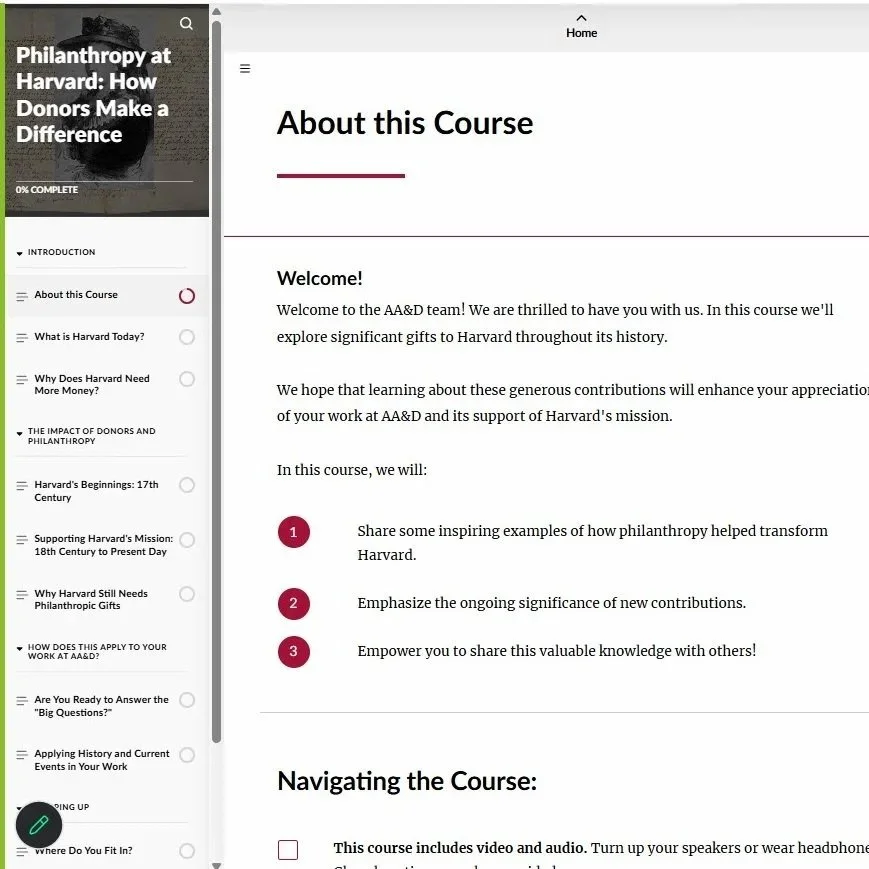
Course Menu Contents
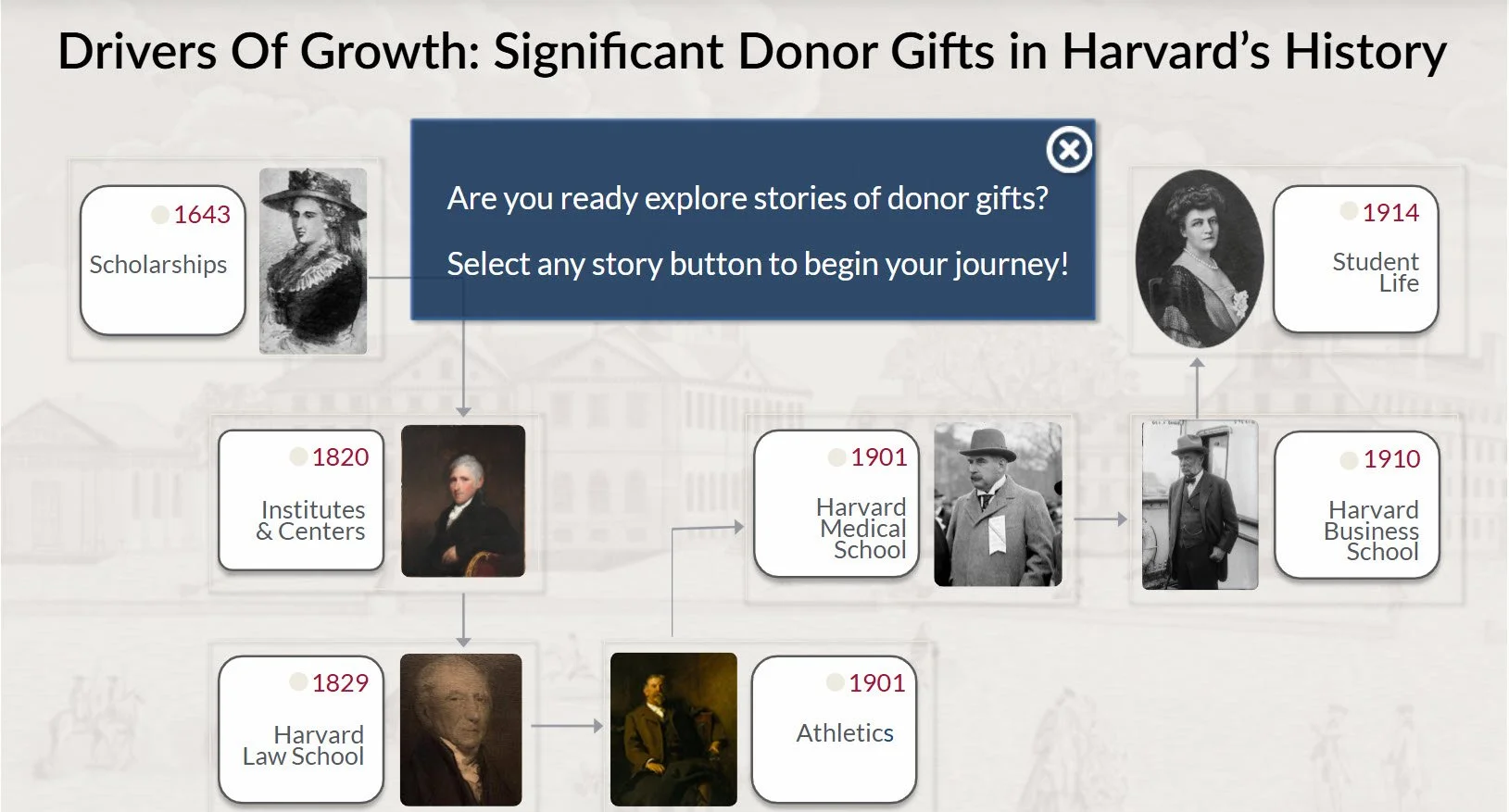
Learner’s Branching Options